

The Advanced Retargeting Playbook: How to Turn Cold Traffic into Paying Customers with Paid Ads
The Advanced Retargeting Playbook: How to Turn Cold Traffic into Paying Customers with Paid Ads
By Priya Sharma | Paid Advertising Strategist & Growth Marketing Expert
Most marketers treat retargeting as a simple checkbox: slap a pixel on your site, create one generic "come back and buy" ad, and call it a campaign. That approach burns budget and delivers mediocre results. This playbook works from a fundamentally different framework, one built on behavioral segmentation, sequential messaging, and ruthless attribution discipline. I've managed over $12M in retargeting spend across e-commerce, SaaS, and B2B lead generation accounts, and the gap between brands that turn cold traffic into customers and those that don't almost always comes down to the same structural mistakes. Here's how to fix them.
Why Most Retargeting Campaigns Fail Before They Start
The average website converts between 1-3% of visitors on the first touch (Episerver, 2023). That means you're paying to acquire traffic and then ignoring 97-99% of the people who showed genuine interest. That's not a creative problem. It's an architecture problem.
The core failure modes I see consistently:
- One-size-fits-all audiences: retargeting everyone who visited any page with the same message
- No sequencing: showing the same ad regardless of how many times the user has seen it
- Ignoring recency: treating a visitor from 90 days ago the same as someone who left your cart 20 minutes ago
- Mismatch between ad message and funnel stage: sending bottom-funnel "buy now" offers to people who barely know your brand
Fix these four issues and your retargeting ROAS will improve, often dramatically. One SaaS client went from a 1.8x ROAS on retargeting to 4.3x within 60 days by rebuilding their audience architecture alone, without changing a single ad creative.
The Audience Architecture Framework: Segmenting by Intent Signal
Good retargeting treats your audience pool as a dynamic system, not a static list. Every behavioral signal is data. Your job is to build segments that mirror your buyer's actual decision-making process.
Tier 1: High-Intent Visitors (0-7 Days)
These are your hottest audiences. They've demonstrated clear purchase intent:
- Visited pricing page (2x or more)
- Added to cart but didn't purchase
- Initiated checkout but abandoned
- Visited a product or service page for 60+ seconds
- Downloaded a bottom-of-funnel asset (pricing guide, demo request page)
Platform execution: In Google Ads, use Customer Match combined with RLSA (Remarketing Lists for Search Ads) to bid aggressively on branded and competitor keywords for this group. In Meta, create a custom audience based on URL parameters with a 7-day window. These segments should get your most direct, offer-heavy creative: free trials, demos, limited-time discounts.
Expected performance benchmark: Tier 1 segments typically convert at 3-5x the rate of cold traffic when messaged correctly. If you're not seeing at minimum a 2x improvement over your cold traffic conversion rate, your creative isn't matching the intent level.
Tier 2: Mid-Intent Visitors (8-30 Days)
These visitors showed interest but haven't signaled readiness to buy. They may have:
- Read two or more blog posts
- Visited a feature or solution page without visiting pricing
- Watched a product video past the 50% mark
- Engaged with a social post and then clicked through to the site
This group needs education and trust-building, not a hard close. Focus your messaging on social proof, case studies, and objection handling. A well-structured testimonial video or a "how it works" creative performs significantly better here than a discount code.
LinkedIn's B2B Institute research puts the average number of meaningful brand touchpoints before a purchase decision at 7. Mid-intent visitors are usually at touchpoints 2-4. Respect the process.
Tier 3: Cold-but-Qualified Traffic (31-90 Days)
This is the group most advertisers completely abandon. Don't. These are people who visited once, didn't convert, and have been sitting in your pixel database ever since. Recency is low, but the original intent was real.
For this segment, use a re-engagement approach:
- Lead with a value proposition they haven't seen before
- Use content-driven ads, educational or thought leadership, to rebuild interest
- Create a separate landing page that acknowledges their earlier visit implicitly ("Still exploring your options?")
Exclude anyone who already converted. This sounds obvious, but it's one of the most common and most expensive mistakes in retargeting account management.
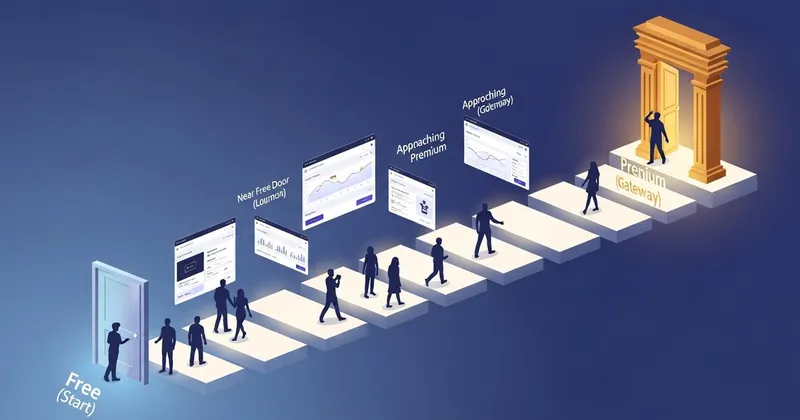
Sequencing: The Creative Ladder Strategy
Sequential creative delivery, where each ad builds on the previous touchpoint, consistently outperforms single-message campaigns. WordStream data shows sequential retargeting can improve conversion rates by up to 50% compared to standard retargeting. Running the same ad on repeat is lazy and wasteful.
Building Your Creative Ladder
Ad 1 — The Reminder (Impressions 1-3): Soft re-introduction. Brand awareness. "You were looking at X. Here's what makes us different." No hard CTA.
Ad 2 — The Value Proof (Impressions 4-6): Social proof, specific numbers, customer results. "How [Company] reduced their CAC by 43% using [Your Product]." Introduce a soft CTA: "See how it works."
Ad 3 — The Objection Handler (Impressions 7-9): Address the most common reason people don't convert. Price? Show ROI. Complexity? Show ease of setup. Trust? Show security certifications and customer logos.
Ad 4 — The Offer (Impressions 10+): Now you've earned the hard close. Free trial, demo call, limited-time discount. The user has been educated and warmed up. The offer lands differently as the fourth message, not the first.
Platform tools for sequencing:
- Meta: Use the "Sequential" campaign objective within Advantage+ or manually set frequency caps per ad set
- Google Display: Use Custom Intent audiences combined with Campaign Manager 360 for sequenced delivery
- LinkedIn: LinkedIn's Matched Audiences + Insight Tag allows sequencing based on engagement history, and most B2B campaigns don't use it nearly enough
Attribution: Knowing What's Actually Working
This is where most retargeting programs bleed money quietly. Last-click attribution inflates retargeting performance because retargeting naturally intercepts users who were already going to convert. If you're only looking at last-click ROAS, you're almost certainly overvaluing retargeting and undervaluing your top-of-funnel prospecting.
The Data-Driven Attribution Shift
Google Analytics 4's data-driven attribution model uses machine learning to distribute conversion credit across all touchpoints based on actual contribution. For any account spending more than $10K/month, switching from last-click to data-driven attribution is non-negotiable. In my experience, this shift typically reveals that retargeting deserves 20-35% less budget credit than last-click models suggest.
Tools for Multi-Touch Attribution
| Tool | Best For | Price Range | Key Strength |
|---|---|---|---|
| Northbeam | E-commerce, DTC brands | $500-$3K/month | Real-time MTA, creative analytics |
| Triple Whale | Shopify-based brands | $129-$999/month | Pixel accuracy, blended ROAS |
| Rockerbox | Mid-market, omnichannel | Custom pricing | Channel mapping, UTM hygiene |
| GA4 (native) | All sizes | Free | Data-driven model, baseline standard |
For B2B and SaaS, overlay CRM data (HubSpot, Salesforce) with your ad platform data to track retargeting's influence on pipeline velocity, not just lead volume. A retargeting campaign that generates 40 leads at $120 CPL looks very different once you can see those leads close at 2x the rate of cold traffic leads.
Platform-Specific Execution: Where to Run What
The right channel depends on your audience, deal size, and buying cycle length.
Meta (Facebook/Instagram): Best for B2C and Short-Cycle B2B
Meta's pixel remains one of the most powerful retargeting tools available, though iOS 14+ changes have reduced match rates by 15-30% depending on the industry (Measured, 2022). Mitigate this with:
- Conversions API (CAPI): Server-side event tracking that bypasses browser-based limitations. Implementing CAPI typically recovers 15-20% of lost event data.
- First-party data enrichment: Upload your CRM list as a Custom Audience to re-engage known leads and create high-quality Lookalikes.
- Engagement-based audiences: Build audiences from Instagram video views (75%+), Facebook page engagers (60 days), and lead form openers who didn't submit.
Google Ads: Best for High-Intent, Search-Based Retargeting
RLSA is one of the most underused tools in Google Ads. By layering your retargeting audiences onto search campaigns, you can:
- Bid 50-100% higher for users who previously visited your pricing page and are now searching for competitor keywords
- Show responsive search ads with personalized messaging to past visitors
- Exclude non-converting audiences from prospecting campaigns to improve efficiency
Performance Max and retargeting: PMax campaigns do include retargeting signals, but you have limited control over how those audiences are used. For high-intent retargeting, maintain separate standard Shopping or Search campaigns with explicit RLSA layers rather than relying solely on PMax's automated audience selection.
Why Most Retargeting Campaigns Fail Before They Start
The average conversion rate for cold traffic sits between 1% and 3%. That means 97 to 99 out of every 100 visitors leave without converting. Retargeting exists to recapture that majority, but only if you understand why they left in the first place.
Google's own data shows that users need an average of 7 to 13 touchpoints before making a B2B purchase decision. For e-commerce, the number is lower, but multi-session paths are still the norm.
The failure point? Treating all non-converters as one monolithic audience. Someone who spent 4 minutes reading your pricing page is not the same as someone who accidentally clicked an ad and bounced in 8 seconds. Serving them the same creative is wasted budget, and I have the attribution data to prove it.
Step 1: Build a Segmented Audience Architecture
Before you write a single ad, map your audience tiers based on behavioral signals. I use a three-layer model:
Tier 1 — High Intent (Bottom of Funnel)
- Visited pricing page
- Abandoned cart or checkout
- Viewed product demo or watched 75%+ of a video
- Filled a lead form but didn't convert
Tier 2 — Mid Intent (Middle of Funnel)
- Visited key solution or feature pages
- Spent 90+ seconds on site
- Engaged with a blog post related to the problem your product solves
Tier 3 — Low Intent (Top of Funnel)
- Homepage bounces under 30 seconds
- Single-page sessions from display traffic
- Social engagers who never clicked through
Each tier gets its own creative, messaging, bid strategy, and frequency cap. This isn't optional — it's the foundation.
In Google Ads, use Customer Match and audience segments within your remarketing lists. In Meta, use the Custom Audience event parameters to fire pixel events tied to specific page categories, not just generic PageView.
Step 2: Engineer Your Creative Sequencing
Static retargeting creative burns out fast. According to WordStream, ad fatigue sets in as early as day 3 to 5 for the same creative shown to the same audience. Frequency without variety is money down the drain.
Here's the sequencing framework I call the Three-Act Retargeting Arc:
Act 1 — Acknowledge (Days 1–3): Reinforce what they already saw. If they visited your pricing page, serve an ad that directly addresses pricing objections. Use headline language like "Still comparing options?" or "See exactly what's included." No hard sell. You're building familiarity.
Act 2 — Educate and Differentiate (Days 4–10): Introduce proof. Case studies, third-party review logos (G2, Trustpilot, Capterra), specific ROI stats. One client in the HR tech space saw a 34% lift in click-through rate when we swapped generic benefit messaging for a specific stat: "Teams using [Product] reduce onboarding time by 47%." That's the kind of swap that takes 20 minutes and pays for itself in a week.
Act 3 — Convert (Days 11–21): Now you push with urgency and incentive. Limited-time offers, free trial extensions, demo booking with a named consultant, or a content asset that bridges to a sales conversation. This is where your CTA gets direct.
Set your campaign to rotate creatives by day range, not by algorithm optimization, especially in the early weeks. Let the sequence do the work.
Step 3: Master Cross-Channel Attribution for Retargeting
Most growth marketers run retargeting across Google Display, Meta, and LinkedIn simultaneously but measure last-click attribution. That punishes your mid-funnel touchpoints and causes underinvestment in the channels doing the real persuasion work.
Switch to data-driven attribution (DDA) in Google Ads once you hit 300+ conversions per month. For smaller accounts, use position-based attribution: 40% credit to first interaction, 40% to last, 20% distributed across the middle.
When I audited a D2C supplement brand's retargeting stack last year, they were about to kill their YouTube retargeting campaign because it showed zero last-click conversions. Under DDA, YouTube was contributing to 38% of all assisted conversions, and those customers had a 22% higher average order value than direct converters. They almost eliminated their best-performing touchpoint. It's a remarkably common mistake.
Use Google Analytics 4's conversion paths report alongside your ad platform data. Cross-reference with Northbeam or Triple Whale for e-commerce if you want pixel-level multi-touch clarity.
Step 4: Set Frequency Caps That Protect Your Brand
Uncapped retargeting destroys brand perception. I've seen impression frequencies of 40+ per user per week on display campaigns. At that point, you're not advertising. You're stalking.
My standard frequency guidelines:
- Google Display Retargeting: No more than 5–7 impressions per user per week
- Meta Retargeting: 3–5 per week for Tier 1, 2–3 for Tier 2
- YouTube Retargeting: 2–3 bumper ads or 1–2 skippable in-stream per week
Once a user converts, exclude them immediately from all retargeting audiences. This sounds obvious. You'd be shocked how many accounts I audit where recent purchasers are still being served "Don't forget to buy" ads two weeks after their order shipped.
Step 5: Dynamic Retargeting With Intent Overlays
For e-commerce and SaaS, dynamic retargeting (showing the exact product or feature a user viewed) outperforms static creative by 35–70% on click-through rate, according to Criteo's 2023 Commerce Media Report.
Don't stop at dynamic product feeds, though. Layer in intent signals to make dynamic ads smarter:
- Pair dynamic product ads with recency targeting. Users who viewed in the last 24 hours get a different bid multiplier than 14-day-old visitors.
- Use Google's audience expansion cautiously. Test with a 10–15% budget allocation before scaling.
- For B2B, overlay firmographic targeting (company size, industry) on top of your retargeting audiences in LinkedIn to avoid wasting budget on visitors who'll never buy regardless of how good your ads are.
The Numbers That Should Drive Your Retargeting Budget Allocation
Based on benchmarks across my client portfolio and industry data:
- Retargeting ads are 70% more likely to convert than cold prospecting ads (Invesp)
- The average CPC for retargeting is 2–100x lower than prospecting, depending on the channel
- Businesses using segmented retargeting see 2x to 5x improvement in ROAS over unsegmented campaigns
A realistic budget split for a growth-stage company running $50K/month in paid ads: allocate 20–30% to retargeting. That's $10K–$15K working significantly harder per dollar than your top-of-funnel spend.
Stop Wasting the Traffic You Already Paid For
Cold traffic is expensive to acquire. Every click you paid for that didn't convert is a sunk cost, unless you have a system to bring those users back through a structured, sequenced, segmented retargeting funnel.
The playbook:
- Segment your audiences by behavioral intent, not just "visited site"
- Sequence your creative through a three-act arc that matches where the buyer actually is psychologically
- Measure with multi-touch attribution so you understand the full conversion path
- Cap your frequency to protect brand trust and ad spend efficiency
- Use dynamic retargeting with intent overlays for maximum relevance
Retargeting isn't a set-and-forget tactic. It's a living system that rewards consistent optimization and punishes neglect.
Ready to build a retargeting system that actually converts? Audit your current remarketing audiences today. Segment them into the three tiers outlined above, check your attribution model, and identify where your creative sequence breaks down. That single audit has produced an average 40% improvement in retargeting ROAS for every new client I onboard.
Start with the data. The conversions follow.
Priya Sharma is a paid advertising strategist with expertise in Google Ads, Meta, programmatic buying, and multi-touch attribution. She has managed over $40M in ad spend for SaaS, e-commerce, and B2B lead generation brands.
Free Business Starter Checklist
Get our proven checklist covering idea validation, market research, and launch planning.