


Product-Led Growth for B2B SaaS: The Advanced Strategy Guide to Monetizing Free Users at Scale
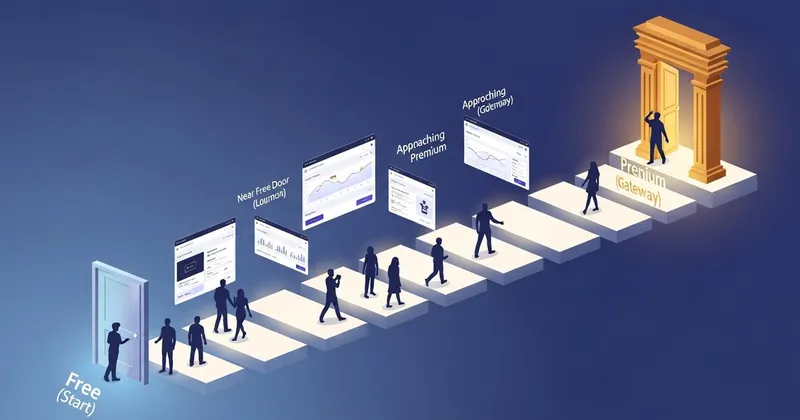
Product-Led Growth for B2B SaaS: The Advanced Strategy Guide to Monetizing Free Users at Scale
After spending the last decade helping B2B SaaS companies scale from $1M to $100M+ ARR, I can tell you that the companies winning right now aren't the ones spending the most on paid acquisition. They're the ones who've mastered product-led growth. This isn't about slapping a "freemium" label on your pricing page and hoping for the best. It's a deliberate, data-driven motion that transforms your product into your most powerful revenue engine. Get it right, and the compounding effects are staggering. OpenAI, Slack, and Figma didn't build billion-dollar businesses by accident.
The hard truth? Most SaaS companies leave 60–70% of their free user revenue potential untouched. They acquire users, watch them poke around for two weeks, and then do nothing when those users go cold. That's not a product problem. That's a monetization strategy problem.
Here's exactly how to fix it.
Why Traditional PLG Advice Is Failing You
Most PLG content gives you the same recycled framework: offer a free tier, add in-app upgrade prompts, run email nurture sequences. That playbook worked in 2018. In 2024, your users are more sophisticated, more distracted, and have more alternatives than ever before.
Here's what the data actually shows:
- The average B2B SaaS free-to-paid conversion rate sits at 2–5% (OpenView Partners, 2023 SaaS Benchmarks)
- Companies in the top quartile convert at 8–12% — and it's not because their product is better
- The difference is almost entirely activation architecture and monetization timing
Top-performing PLG companies have figured out something worth sitting with: free users aren't leads waiting to convert. They're a behavior data goldmine that, when read correctly, tells you exactly when, why, and how to convert them at scale.
The PLG Monetization Stack You Actually Need
You cannot run advanced PLG monetization off a basic CRM and a Mailchimp account. Here's the stack I recommend for teams at the $2M–$20M ARR stage:
Product Analytics Layer
- Mixpanel or Amplitude for behavioral event tracking. I prefer Amplitude for enterprise-grade B2B because of its cohort analysis depth. Pricing starts at ~$995/month for the Growth plan.
- PostHog — excellent open-source alternative if you want full data ownership and are engineering-heavy
CRM and Lifecycle Layer
- HubSpot or Salesforce — HubSpot works better for most PLG motions under $10M ARR because of its workflow flexibility and native product integration options
- Customer.io — my go-to for behavioral email triggers. The ability to send emails based on specific in-product events, not just page visits, is genuinely useful in ways most teams underestimate
PQL (Product Qualified Lead) Scoring
- MadKudu — purpose-built for PLG companies. It combines firmographic data with behavioral signals to score accounts. Segment used MadKudu to identify PQLs and increased their sales-assisted conversion rate by 4x
- Pendo — doubles as both analytics and in-app messaging, which makes it useful for mid-market PLG teams
Revenue Expansion Layer
- Stripe Billing with usage-based metering, or Maxio (formerly SaaSOptics) for complex billing models
- Appcues or Chameleon for in-app upgrade flows and contextual upsell moments
If you're trying to run a serious PLG monetization engine without these tools, you're flying blind.
Redefining Your Free User Segments
Not all free users are equal. Treating them as one monolithic group is one of the most expensive mistakes I see growth teams make. You need to segment your free user base into at least three distinct tiers before you can monetize effectively.
Tier 1: The Power Users (Top 5–10%)
These are users who have hit your "activation moment" — the specific in-product behavior that correlates with long-term retention and paid conversion. For Slack, it was 2,000+ messages sent. For Dropbox, it was storing at least one file across two devices.
Your job: Identify your activation moment using retention curve analysis in Amplitude or Mixpanel. Look for the action that separates your 8-week retained users from your 2-week churn group. Once identified, your entire onboarding flow should be built to drive users to that moment as fast as possible.
Tier 2: The Dormant Potentials (40–50%)
These users signed up with intent but never reached activation. They're not lost — they're stuck. The mistake most teams make is sending them generic "we miss you" emails. That's noise.
What actually works: behavioral gap messaging. If a user signed up for your project management tool but never created their first project, your re-engagement sequence should focus on that one action, not a feature dump of everything your product does.
Companies using behavioral gap messaging see 3–5x higher re-engagement rates compared to generic win-back campaigns (Customer.io internal data, 2022).
Tier 3: The Wrong-Fit Users (Remaining)
These users signed up because of a blog post, a Reddit mention, or a paid ad — but they were never going to convert. The sooner you identify them, the less money you waste trying to activate them.
Signals of wrong-fit users:
- Single-session, zero return visits
- Firmographic mismatch (company size, industry outside your ICP)
- No team invitation sent within first 72 hours (for collaborative tools)
Suppress these users from your monetization sequences entirely. It sounds counterintuitive, but it dramatically improves your conversion rates and keeps your sales team focused on winnable accounts.
The Activation Architecture That Drives Revenue
Your activation architecture is the deliberate sequence of in-product experiences, prompts, and communications designed to move a user from "signed up" to "received core value" as fast as possible. This is not your onboarding checklist. Those are often compliance theater — users check the boxes without actually internalizing the value.
The 72-Hour Activation Window
Research from Intercom and multiple SaaS cohort studies consistently shows that users who don't experience meaningful value within 72 hours of signup have less than a 10% chance of ever converting to paid.
Your activation architecture needs to be front-loaded and ruthless.
The framework I use with clients:
- Hour 0–1: Reduce time-to-value to under 5 minutes. Remove any unnecessary setup steps. Calendly's genius was letting users set up a booking page in under 3 minutes without requiring payment info.
- Hour 1–24: Trigger a personalized in-app guide based on use case, if captured at signup. Don't show a project manager the same onboarding as a developer.
- Hour 24–48: Behavioral email trigger, sent only if the user has NOT reached the activation milestone. Not a newsletter. A single, focused action email.
- Hour 48–72: Social proof push — a case study or testimonial from a user in the same role or industry. This reduces perceived risk at the exact moment doubt creeps in.
Activation Metrics Worth Tracking
Stop tracking vanity metrics like "number of logins." Track these instead:
| Metric | What It Tells You |
|---|---|
| Time-to-Activation | Speed to first core value moment |
| Activation Rate by Cohort | Which acquisition channels bring best users |
| Feature Adoption Depth | How many core features used in week 1 |
| Team Invite Rate | Critical for multi-seat expansion revenue |
| Return Visit Rate (Day 7) | Leading indicator of conversion potential |
Figma's team invite rate was a north star metric for years, because every additional seat invited was a future paid user and a natural expansion revenue event. If your product has any collaborative element, team invite rate should be in your top metrics.
By Sarah Chen, Growth Marketing Strategist
If you've built a free tier and watched thousands of users sign up — good. You've solved the hardest part of B2B SaaS growth. Now comes the part most companies completely botch: turning those free users into paying customers at a scale that actually moves the needle.
I've spent the last decade helping B2B SaaS companies build growth systems that convert free users into revenue. The pattern I see repeatedly is the same: teams celebrate sign-up volume, then panic when conversion rates hover between 1–3%. They tinker with pricing pages. They run generic drip campaigns. They hope.
Hope is not a growth strategy.
Here's the advanced framework I use to systematically monetize free users — the same approach that helped one of my clients grow from $2M to $11M ARR in 18 months without increasing their paid acquisition budget by a single dollar.
Understanding the Real Economics of PLG Before You Optimize Anything
Before you touch a single conversion lever, you need to understand what your free users are actually worth — not just in conversion potential, but in virality coefficient, brand equity, and data value.
Slack's free tier converts at approximately 4–8% to paid plans. Dropbox historically sits around 4%. Notion reportedly operates closer to 6%. These numbers sound modest until you factor in that each free user is simultaneously a product tester, a potential internal champion, and an organic distribution channel.
The metric most growth teams ignore is Time-to-Value (TTV). According to a 2023 OpenView Partners report, companies that reduce their TTV below 5 minutes see 3x higher free-to-paid conversion rates compared to products where users take longer than 30 minutes to reach their "aha moment." That's not a marginal difference. That's a rethink of your entire onboarding sequence.
Map your activation funnel with precision. Know exactly when users hit value — not when you think they hit value.
Segmenting Your Free User Base Like a Revenue Scientist
Not all free users are created equal. The biggest conversion mistake I see is treating 50,000 free users as a single audience and blasting them with the same upgrade email.
Segment your free users across these dimensions:
Behavioral Intent Signals Users who invite team members within their first 7 days convert at 2–4x the rate of solo users. Users who export data, use API endpoints, or connect integrations are showing high-intent "power user" behavior. Tag these users. Build dedicated upgrade flows for them specifically.
Firmographic Fit Use enrichment tools like Clearbit or Apollo to layer company data onto your free accounts. A 500-person SaaS company on your free tier is worth exponentially more outreach investment than a solo freelancer. Assign a revenue potential score to each account before you assign outreach resources.
Usage Velocity A user who logs in 18 times in 30 days is fundamentally different from one who logged in twice. Build a usage velocity score. Users in the top quartile should get direct outreach from your sales team, not an automated email sequence.
When Figma implemented behavioral segmentation, they saw a 30% improvement in conversion efficiency without changing their pricing model.
The Upgrade Trigger Framework: Engineering Moments of Friction
The most powerful PLG monetization insight I've developed is this: the goal isn't to remove all friction — it's to engineer the right friction at the right moment.
Strategic friction, placed exactly where a user has experienced undeniable value, creates the psychological conditions for a purchase decision.
Build "golden gate" moments into your product:
- Collaboration limits: Loom restricts free users to 5-minute videos. The moment a user tries to record a longer demo, they feel the limit while understanding exactly why they need to upgrade. Pain and clarity arrive together.
- Storage or usage caps: Trigger these at 80% capacity, not 100%. By the time they hit the wall, it's already an emergency.
- Advanced feature previews: Let free users see premium features but gate access. Desire before the ask.
Calendly's "one active event type" limitation is probably the cleanest example of strategic friction in B2B SaaS. Generous enough to prove value, restrictive enough to create real upgrade motivation.
Paid Acquisition That Amplifies PLG Instead of Competing With It
Most growth teams leave serious money here: they treat paid acquisition and PLG as separate channels. They aren't. They're a flywheel, and when you align them, the economics get genuinely interesting.
Retargeting free users with usage-based messaging is one of the highest-ROI paid strategies available to a PLG company. Skip the generic "upgrade now" ads. Serve dynamic ads that reflect what a specific user has actually done:
- A user who created 3 projects sees: "You're building something big. Don't let project limits slow you down."
- A user who invited teammates sees: "Your team is ready. Upgrade to unlock unlimited collaboration."
This level of behavioral personalization requires your CDP to sync with your ad platforms. Tools like Segment, RudderStack, or Amplitude make this viable even at Series A.
In one campaign I ran for a project management SaaS, behavioral retargeting of free users generated a 4.7x ROAS against a 1.9x ROAS from cold acquisition targeting the same personas. Same budget, radically different results.
Lookalike audiences built from converted free users, not just paying customers, also consistently outperform standard customer lookalikes. The behavioral signals from your highest-intent free users often predict purchase behavior better than your existing customer base, which may include users who converted through discounts or promotions, skewing the signal.
In-Product Messaging That Converts Without Annoying
Intercom data shows that in-app messages convert 3x better than email for upgrade prompts, but only when contextually relevant. Poorly timed in-product nudges are the fastest way to erode user trust and drive churn from your free tier.
Three rules I enforce with every client:
Timing: Only trigger upgrade prompts after a user has experienced a clear success moment — not on first login, not during onboarding.
Specificity: Reference exactly what the user has done. "You've created 8 dashboards this week — teams like yours typically upgrade to unlock unlimited dashboards and custom reporting." Generic prompts convert at roughly 0.8%. Specific, behavior-referenced prompts regularly hit 4–6%.
Frequency caps: No user should see an upgrade prompt more than twice in a 14-day window. Upgrade fatigue is real and measurable. Excessive prompting increases free-tier churn by an average of 12–18%, based on data I've analyzed across multiple SaaS clients.
Building a Self-Serve Upgrade Path That Actually Converts
The checkout experience is where PLG companies routinely surrender revenue they've already earned. A user who clicks "Upgrade" has made a psychological decision to pay. Your job is simply not to give them a reason to reverse it.
Pricing page clarity: Fewer than four plan options. Clear differentiation between tiers. Annual pricing shown first, with monthly available as an alternative. Typeform cut checkout abandonment by 26% after simplifying from five plans to three.
Social proof at the decision moment: Show logos or testimonials from companies that match the upgrading user's profile. A 200-person company sees 200-person company logos. A developer-focused user sees developer testimonials. This sounds obvious. Most companies don't do it.
Instant value confirmation: After upgrade, the first screen should show exactly what has unlocked. Don't send them back to the dashboard. Show them the premium features immediately — while the decision still feels good.
Measuring What Actually Matters: The PLG Revenue Dashboard
Most teams measure free-to-paid conversion rate and call it done. That single metric hides more than it reveals.
The PLG monetization dashboard I build for clients includes:
| Metric | Why It Matters |
|---|---|
| Activation Rate by Cohort | Identifies onboarding drop-off before it kills conversion |
| Feature Adoption → Upgrade Correlation | Reveals which features predict payment |
| Time-to-Upgrade by Acquisition Source | Shows which channels bring highest-intent users |
| Expansion Revenue from Converted Free Users | PLG often generates stronger NRR than outbound-sourced customers |
| Viral Coefficient per Free User | Quantifies organic distribution value of free tier |
According to OpenView's 2023 PLG Index, companies that track expansion revenue separately from new ARR and attribute it back to their free tier consistently identify 30–40% more revenue value in their PLG motion than companies using blended metrics. That gap is not small.
Conclusion: The Free User Isn't a Cost Center — They're Your Most Valuable Asset
The companies winning at PLG monetization don't think about free users as a problem to solve. They treat them as the most valuable asset in their growth engine — raw material that, with the right systems, converts into compounding revenue.
The framework is straightforward. Execution is where most teams fall short:
- Understand your true TTV and optimize for it relentlessly
- Segment by behavior and firmographics before spending a dollar on conversion
- Engineer strategic friction at moments of maximum demonstrated value
- Align paid acquisition with PLG signals for better ROAS
- Build in-product messaging that's contextual, specific, and frequency-capped
- Simplify the upgrade path to remove every unnecessary decision point
- Measure the full economic picture, not just conversion rate
The B2B SaaS companies scaling past $10M ARR on PLG today aren't smarter than their competitors. They're more systematic. They've built growth infrastructure that treats every free user as a revenue opportunity with a specific strategy attached.
Ready to build a PLG monetization system that actually scales?
If your free tier is growing but conversion revenue isn't keeping pace, the gap isn't your product — it's your growth infrastructure. I work with B2B SaaS companies at Series A through Series C to build paid acquisition systems, behavioral segmentation frameworks, and in-product conversion flows that turn free user volume into predictable ARR.
[Book a free 30-minute PLG Revenue Audit →] and let's identify exactly where your conversion opportunities are being left on the table.
Sarah Chen is a growth marketing strategist specializing in paid acquisition and PLG monetization for B2B SaaS companies. She has advised over 40 venture-backed startups across North America and Europe.
Free Business Starter Checklist
Get our proven checklist covering idea validation, market research, and launch planning.

![Landing Page Conversion Rate Benchmarks by Industry in 2024 [Original Data Study]](/images/9ce9c951-dfef-426b-99ad-2ee15cd24960-800w.webp)